Francis’s father, Pietro, was a prosperous cloth merchant, and his mother, Pica, came from a noble family. Raised in comfort, Francis dreamed of knighthood and glory. In 1202, at around 20 years old, he joined a military campaign against neighboring Perugia, but the venture ended in disaster. Captured and imprisoned for a year, Francis fell gravely ill, an experience that began to crack his worldly ambitions. After his release, he tried again for martial fame in 1205, joining a papal army headed to Apulia. Yet a vision halted him just a day into the journey—a voice told him to “serve the master, not the man.” Confused but stirred, Francis returned to Assisi.
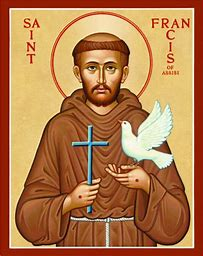
St. Francis of Assisi (1181/1182–1226) is one of history’s most beloved saints, a man whose radical embrace of poverty, love for nature, and pursuit of peace continue to inspire millions. Born Giovanni di Pietro di Bernardone in Assisi, Italy, he was nicknamed “Francesco” (meaning “the Frenchman”) by his father, likely due to his mother’s French heritage or his father’s business ties to France. His early life bore little resemblance to the humble saint he’d become—he was a child of wealth, reveling in fine clothes, parties, and the carefree life of a merchant’s son.
This marked the start of his spiritual awakening. While praying in the dilapidated church of San Damiano, Francis heard Christ speak from the crucifix: “Go, repair my house, which is falling into ruin.” Taking it literally, he sold his father’s cloth to fund the church’s restoration—an act that enraged Pietro. In 1206, their conflict came to a head in a public showdown before the bishop of Assisi. Francis renounced his inheritance, stripped off his fine clothes, and walked away naked, vowing to live in poverty. Clothed only in a rough tunic, he began a life of radical simplicity.
Francis’s mission crystallized in 1209 after hearing a Gospel passage about Jesus sending his disciples out with nothing—no money, no extra clothes, just faith. Inspired, Francis founded the Friars Minor (meaning “lesser brothers”), a movement dedicated to living as Jesus did: poor, humble, and reliant on God’s provision. He and his growing band of followers begged for food, preached in the streets, and served the sick, especially lepers, whom Francis once feared but came to embrace as “brothers.” His joyful spirit drew hundreds, then thousands, to the order, which was officially approved by Pope Innocent III in 1210.
Central to Francis’s life was his love for creation. He saw God in everything—calling the sun, moon, and animals his “brothers” and “sisters.” His Canticle of the Creatures, written late in life, is a poetic hymn praising God through nature: “Brother Sun,” “Sister Moon,” “Brother Wind.” Stories abound of his connection to animals—he preached to birds, tamed a wolf terrorizing the town of Gubbio, and once freed a rabbit from a trap, urging it to be more careful. This deep ecological spirituality resonates today, earning him the title of patron saint of animals and the environment.
Francis’s commitment to peace was equally striking. In 1219, during the Fifth Crusade, he traveled to Egypt, walking unarmed into the camp of Sultan al-Kamil to share the Gospel. Though he didn’t convert the Sultan, the two reportedly parted with mutual respect—a rare moment of dialogue amid bloodshed. Back in Italy, Francis mediated disputes between warring towns, embodying his famous prayer (attributed to him, though likely later): “Lord, make me an instrument of your peace.”
Despite his growing fame, Francis remained humble, often calling himself “the least of men.” In 1223, he created the first nativity scene in Greccio, using real animals and a manger to make Christ’s birth tangible for villagers—a tradition that endures globally. That same year, he received the stigmata, the wounds of Christ, during a vision on Mount La Verna, becoming the first recorded person to bear these marks. The pain of the stigmata, along with chronic illness from years of fasting and exposure, weakened him.
By 1226, Francis was nearly blind and frail. He died on October 3 at age 44, lying on the bare earth at his beloved Porziuncola chapel in Assisi, singing Psalm 141. He was canonized just two years later in 1228 by Pope Gregory IX. His legacy endures through the Franciscan Order, which spread worldwide, and his timeless example of living simply, loving deeply, and walking gently on the earth. St. Francis remains a beacon of what it means to live the Gospel not just with words, but with every step.
 The Barefoot Path